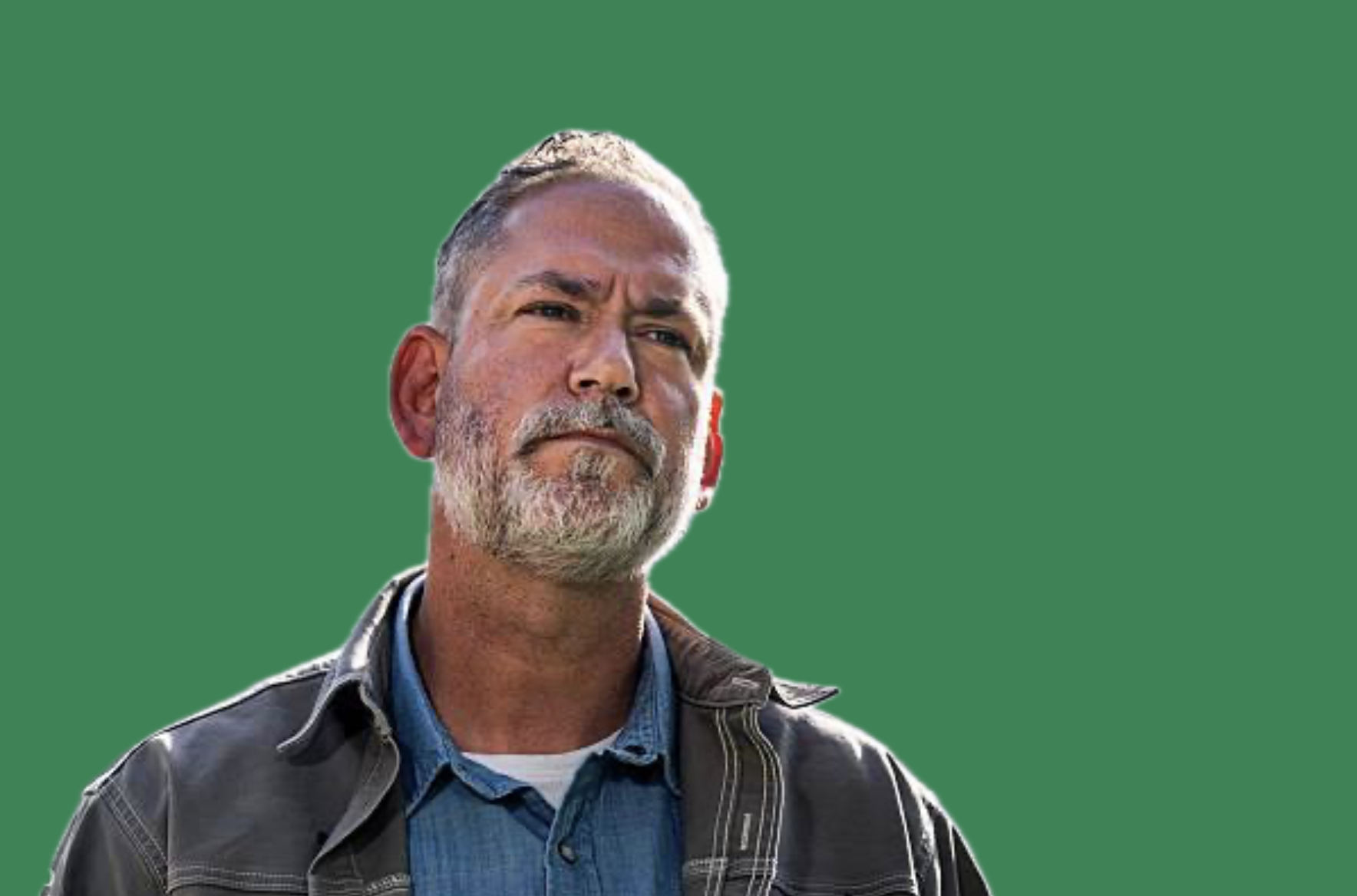
Looking back, it seemed like the perfect matchup: a tattooed, raspy-voiced union mechanic pitted against the heir to a billion-dollar fortune. One candidate wears a welding hood decorated with an American flag. The other, it seems, has never left the insular comfort of oak-paneled boardrooms.
But that scruffy-sounding mechanic, Dan Osborn, an Independent loosely affiliated with Democrats, lost to Sen. Pete Ricketts, the Republican son of a billionaire in one of the few Senate races this year where the left-leaning candidate fell short.
Democrats had high hopes for Osborn: the Navy veteran and ex-union leader arose from complete political obscurity two years ago, nearly besting Nebraska GOP Sen. Deb Fischer in a massive red wave election cycle. In ruby-red Nebraska, the same state Donald Trump won that year by roughly 20 points, Osborn narrowed his margin down to a mere seven points. Beyond campaigning as a populist political outsider, Osborn dabbled with ideological elements of both sides of the aisle, calling for the restoration of Roe while simultaneously bad-mouthing Democratic immigration policy.
Nonetheless, left-leaning operatives were impressed with his electoral overperformance in 2024, prompting Osborn to hop into the state’s 2026 Senate race. While two years ago Osborn managed to meticulously portray Sen. Fischer as a corrupt Washington insider, Beltway profiteer, and senatorial backbencher, it seemed like the union mechanic already had his cards stacked in his favor in his race against Ricketts. Ricketts was appointed—never elected—to the position of senator. Ricketts repeatedly voiced support for president Donald Trump’s tariff agenda, even as farmers and ranchers across the Cornhusker struggled to stomach rising costs and smaller markets. Plus, Ricketts received considerable backlash for a series of questionable pardons while serving as Nebraska’s governor.
But even with the momentum behind Osborn, Osborn could not pull it off last Tuesday.
Beyond a slew of kooky, seemingly low-budget ads, Osborn appeared to be neck-and-neck with (if not occasionally ahead of) Ricketts in most non-partisan polls. He embraced the economically populist message that resonated deeply with American voters this November, and raked in nearly $10 million in cash. But the Dan Osborn of 2026 was not, unfortunately, the Dan Osborn of 2024.
In 2024, his campaign ran a series of whip-smart (and likely higher-budget) ads, featuring Nebraskans who planned to split their tickets for Trump and Osborn. One ad claimed his Republican opponent, Sen. Fischer, had “more in common with Hillary Clinton than Donald Trump.” In a state like Nebraska and year like 2024, that was an astute line of attack from the Osborn camp. The problem, however, for the Osborn of 2026 is that the president’s brand is so underwater that there is little room to loosely praise Trump or woo his supporters.
Osborn’s 2024 success was largely attributed to his ability to distance himself from national Democrats, a label that was practically poison at the time in most parts of rural America. He could dog Hillary Clinton, then praise Donald Trump as an much-needed outsider, and, in the next breath, lambast the ‘country club’ Republican establishment. Furthermore, Osborn wielded incredible political versatility: his chief advisors were ex-aides of Sen. Bernie Sanders but many of his key supporters would call the Vermont senator an America-hating bolshevik. It turns out the “I” next to his name did him plenty of favors.
But as we saw last week, the Democratic brand is on the rise. To many disillusioned Americans, the idea of voting for an Independent, and not a Democrat, felt counterintuitive. This year, Osborn could not find clever ways to incorporate the Democratic brand without turning away steadfast conservatives. He could not treat the party brand as poison like he did in 2024 without the risk of alienating too many pumped-up Democrats. It is understandably challenging to openly and constantly rebuke the Democratic label—much like he did with the Hillary Clinton ad—when the party is experiencing a meteoric resurgence. But it seemed Osborn felt visibly uncomfortable openly embracing the party too.
And this challenge proved to be the hurdle that kept Osborn from an celebrating an election night triumph.
Osborn, however, was not the only loosely-Democratic Independent to fall short this cycle. In South Dakota and Idaho, Independents Brian Bengs and Todd Achilles lost head-to-head matchups against Fischer-like members of the Senate Republican Conference. In a sprawling eastern Washington congressional district, Marine veteran and firefighter Nate Powell lost in the state’s May jungle primary, failing to secure one of two spots in the November general election. In Alaska’s at-large congressional district, Independent Bill Hill looks poised to fall to incumbent GOP Rep. Nick Begich III, largely because a small fraction of voters favored Democrat Eric Hafner, a convicted felon who managed to find his way onto the general election ballot despite never living in or visiting Alaska. The Alaska Democratic Party threw its support behind Hill, but roughly 16,000 voters still voted for Hafner, a sign of the incredible momentum powering little-known (and in this case felonious) candidates. Finally, in the Montana Senate race, former university president Seth Bodnar lost to Kurt Alme, largely due to the unfortunate case of a questionably Democratic spoiler.
In Nebraska and beyond, this was not the year of the Independent. As voters across the country swung left, this movement of socially conservative and economically liberal who refused to pick between the ‘lesser of two evils‘ fell painfully flat, testing the limits of what I call the ‘Osborn experiment.’ It is not time to rule out the Osborns of the world entirely, but there are some cycles where the Independent playbook might backfire on Democrats. 2026 was one of them.