
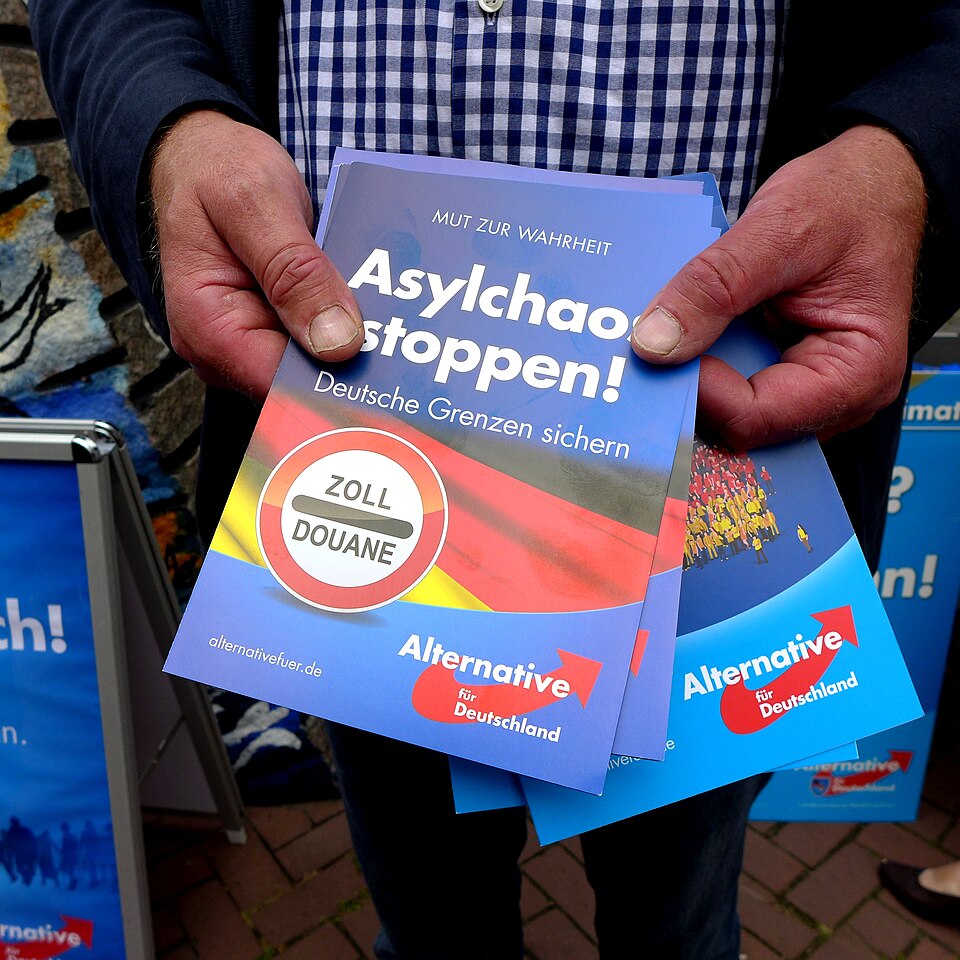
Alternative for Germany’s rise to power raises questions about their message
In September 2026, the Alternative for Germany (AfD) party won the regional parliamentary elections in Saxony-Anhalt, a state in north western Germany. This marked the first time a far right party has been elected in Germany since World War II. The AfD brands itself as a right wing, populist, and anti-immigrant party. It campaigns on strict rhetoric that condemns Islam and promotes ultranationalism. The party has cast a wide net of international supporters: trillionaire Elon Musk, President Donald Trump, and even close associates of Russian president Vladimir Putin.
In the Saxony-Anhalt elections last month, AfD won a majority of votes, falling short of an absolute supermajority by three seats. This supermajority would have allowed the AfD to govern the region independently without a coalition. Now, AfD must form a coalition with another party to form a government. However, it is highly unlikely that a coalition will form due to a “firewall” that prevents the main German parties from collaborating with parties deemed extremist by German intelligence agencies. AfD leader Alice Weidel labeled this practice, which was put into place to prevent a future Nazi regime, as “deeply undemocratic.” Regardless of if this mechanism is undemocratic or not, the rise of German nationalism represents a broader and more problematic shift.
The AfD has turned heads with divisive stances on topics like German history, NATO and European support, and immigration and Islam in the country. In a controversial live stream on X featuring Elon Musk, AfD chief Alice Weidel classified the Nazi’s as “socialists” and Hitler as “communist.” In 2018, Alexander Gauland, the then co-head of the AfD said “Hitler and the Nazis are just bird poo in over 1,000 years of successful German history.” This comment drew extreme outrage from many Germans. Germans across the political spectrum characterized the statement as disrespectful and a poor attempt to cover up the horrors of the Holocaust.
In a recent interview with commentator Mehdi Hasan, Maximiallian Krah, a major face within the AfD, claimed that the AfD is similar politically to the United States’ Republican Party under Donald Trump, and denied accusations of extremism. Krah, of course, is the same politician who famously said “not all members of the Nazi SS were criminals.” This statement prompted backlash from Germans, forcing Krah to step down from the party leadership. Even Marine Le Pen, the leader of France’s far-right, cut ties with Krah due to this statement.
Major criticism of the AfD also comes from the party’s stance on both immigration and Islam’s presence in Germany. Hans-Thomas Tillschneider, a victorious AfD politician from Saxony-Anhalt, claimed that “Islam is foreign to [Germany] and for that reason it cannot invoke the principle of religious freedom to the same degree as Christianity.” Critics, however, adequately point out this position almost entirely violates the German constitution. The fourth article of the nation’s constitution provides that “freedom of faith and of conscience and freedom to profess a religious or philosophical creed shall be inviolable.” AfD, however, does not seem to believe this right to religious freedom is inviolable. According to DW, at a November 2024 event, far-right Austrian politician Martin Sellner told AfD members that immigrants are “burdens to society,” encouraging refugees to leave Europe. According to Correctiv, Sellner’s broad, fiery statement could include naturalized German citizens, meaning these residents’ citizenship would be invalidated. Sellner, however, disputed the November 2024 account, and claimed the report was wholly inaccurate. Opposition to the German right have noticed eerie similarities between Nazi policies and Sellner’s rhetoric.
Circling back to Khar’s debate with Hasan, the latter quoted Alice Weidel distinguishing between “Germans” and “passport Germans,” raising questions of AfD’s belief in a social hierarchy. But even after all of these stumbles, the AfD is inches away from absolute power in Saxony-Anhalt, prompting questions and leaving centrist and left-wing parties anxious and worried.
Now, the question everyone is asking is “What happens next?”. This is not simple. While the AfD leads polls nationwide, the German political system is far different than that of America. To rule independently in a region’s government, a political party must win an absolute majority. The AfD was only three seats short of doing so, presenting the daunting prospect of an AfD-controlled parliament. However, there is a contingency.
Now the question being asked is “what happens next?” The answer is not simple. While the AfD leads polls nationwide, the German political system is not the same as America’s. To rule in an independent government in a region’s government, a political party must win the absolute majority. The AfD was only three seats short of doing so, presenting a daunting prospect of an AfD-controlled parliament. But we must remember: the “firewall” is still standing. While there is pressure on the center-right Christian Democrats to form a coalition with the AfD to start a new government, there has been little movement on that front. Even if the AfD is not able to enter power in Saxony-Anhalt, it scored a major optics victory that will put the political faction ‘on the board’ in other regions. With the rise of ultranationalism and right-wing extremism in Germany, we will likely see an uprising of hate and divisive culture that will only result in a more extreme and hostile political environment.