
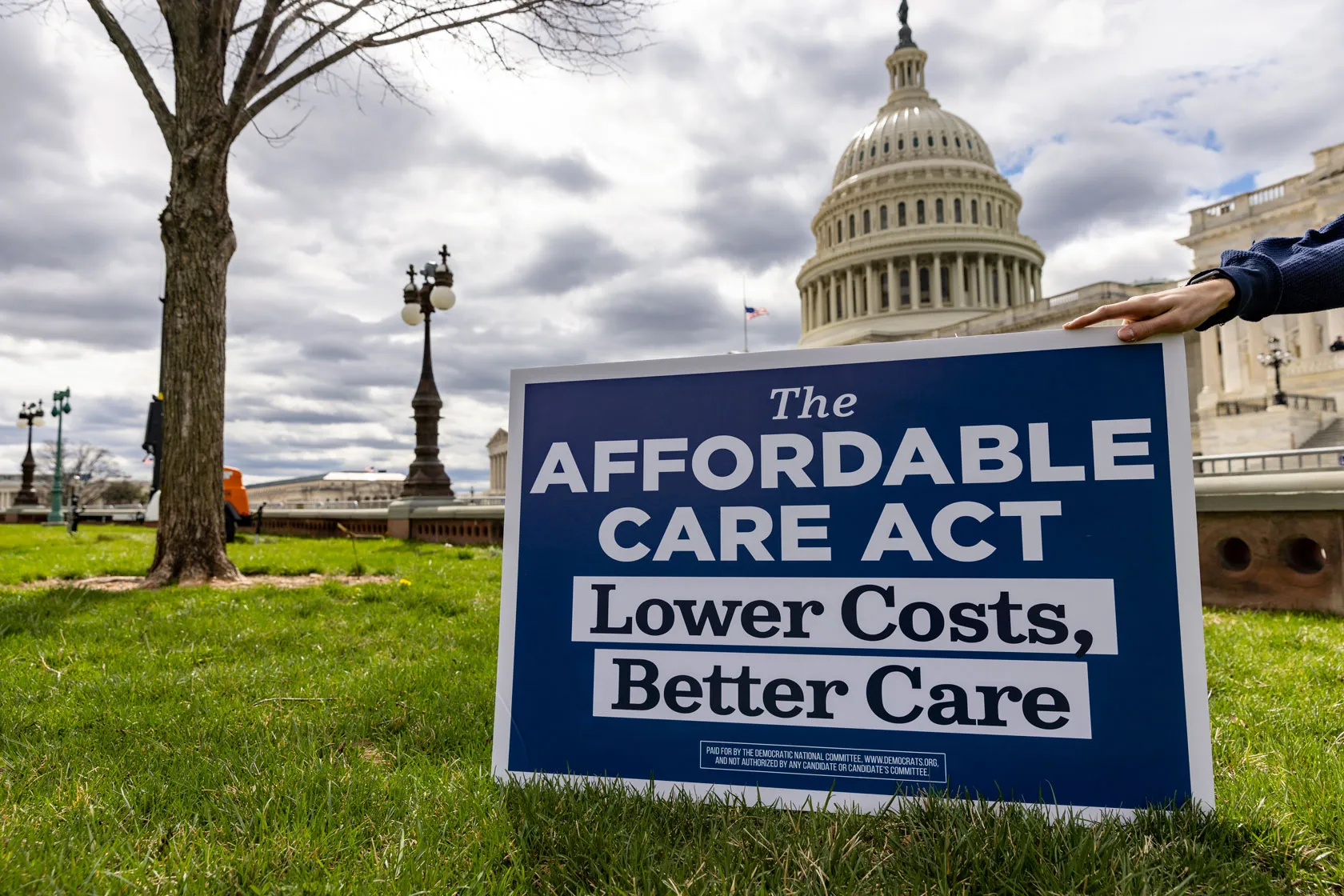
The Affordable Care Act and the Presidential Prerogative
In 1944, President Franklin Delano Roosevelt, offered a bold, sweeping vision for American prosperity in his State of the Union address. Sitting in the Oval Office with his signature black bowtie, speaking into a blocky, metallic microphone in a warm and authoritative voice, Roosevelt described his plan for a reimagined American social contract. His idea, dubbed a Second Bill of Rights, would build upon its constitutional prior. Among these new rights: adequate housing, income, and medical care. It was an ambitious vision, and an innovative framework to help meet the modern challenges of a changing nation.
Despite Roosevelt’s call to remake our health system and his forceful and progressive record of accomplishments, his call for adequate healthcare is yet to be achieved. Eight decades later, that promise remains unfulfilled—nowhere more starkly than in the Trump era.
Under Donald Trump, the healthcare system has come under fire. President Trump has attacked and assaulted his predecessors’ efforts to solve the healthcare crisis. So it is no mistake that, according to the Centers for Disease Control and Prevention, a whopping 27 million Americans do not have health insurance. Reaching everyone with healthcare has been a persistent challenge across administrations, but Donald Trump’s approach is notably incomplete. On the campaign trail in 2016, Trump repeatedly promised to repeal the Affordable Care Act (‘Obamacare’), President Barack Obama’s landmark achievement that transformed the health insurance marketplace for working-class families. Unfortunately for Trump, gutting Obamacare, what he believes to be a “big, fat ugly lie,” is not as easy as it sounds. On his first day in office in 2017, Trump signed an executive order that would minimize the so-called economic burden Obamacare had imposed on Americans. He continued to publicly denigrate the very program that provided healthcare coverage to over 40 million. But in the intervening years, neither private conversations in the White House nor legislative activity on Capitol Hill have yielded a meaningful alternative.
At the end of last year, Obamacare subsidies, which make coverage affordable for low-to-mid income families, expired due to Republican inaction in Congress. According to the Pew Research Center, nearly 22 million Americans rely on the financial support. And without the subsidies, these individuals will see their premiums skyrocket astronomically, squeezing out other essential expenses like food and housing.
Take Caroline Hanssen, a writing specialist from Northern California. In an interview with the New York Times, the 57-year old says her pre-expiration premium sat at $400 per month. Now it has increased to $1,100. Take Tina Jump, a New Jersey resident with diabetes who spoke with CBS News. Her premiums will, like her last name, jump substantially. Or consider Doug Butchart, an Illinois resident whose wife has ALS, the neurological disorder. Speaking to ABC News, Butchart noted his premiums will climb to upwards of $2,000 per month, expenses that he says he simply “can’t afford.”
The Trump administration and Congress’ failure to act is a betrayal to Roosevelt’s aspiring vision for the nation. While Trump campaigned on a promise of reforming healthcare, he has instead delivered a healthcare crisis. His administration weakened the individual mandate, slashed enrollment periods, defunded outreach programs, and promoted incomplete plans that Democrats promptly labeled as “junk”. When subsidies came up for renewal, Republicans in Congress betrayed working families, letting the cost-cutters expire. So it begs the question: how does America honor Roosevelt’s promise for ‘adequate healthcare’?
First, Americans must admit that Obamacare is not perfect. It was, at the time, an important step in the right direction. Yet with its recent expiration, the subsidies program exposed itself as a band-aid on a deeper wound. Unfortunately, the subsidies do not effectively solve the underlying issue: too many Americans can simply not afford healthcare. Fortunately, however, the solution lies not in tearing apart Obamacare but instead returning to what Roosevelt proposed at the Resolute Desk in his black bowtie some eighty years ago: healthcare should be a fundamental right, not a privilege contingent on one’s employment.
Since Roosevelt’s time, it has become increasingly evident that the nation needs a public option for healthcare. The United States Post Office offers a useful parallel. Since private mail carriers cannot or will not serve rural, sparsely-populated communities, the government steps in to ensure universal delivery. This is actually a page from Roosevelt’s playbook. His Tennessee Valley Authority delivered power and utilities to a region bereft of market-oriented service, stringing the power lines and engineering the dams that would electrify the lands along the sprawling Tennessee River. Both the Post Office and the Tennessee Valley Authority are prime examples of what the government can do when the free market fails to serve the greater good.
So far, America’s healthcare system has failed to serve all Americans. This is where a public option comes into play. Without displacing the free market system, the nation can kickstart a program that grants all Americans, regardless of economic status, affordable and reliable healthcare. As Roosevelt recognized in 1944, the notion of adequate healthcare must be accepted as a true, inalienable right.