
After Assad: Syria’s Fragile Transition in a Post-Regime Era
On December 8, 2024, the Assad regime in Syria came to an end after more than fifty years in power. After a rebel military uprising in late November against numerous major Syrian cities, and receiving little resistance from the Syrian military, eventually making it to the capital of Damascus on December 8. That same day, Bashar al-Assad fled to Russia, a longtime ally of the regime, where he remains in exile, reported to be living a lavish lifestyle.
Russian forces did not provide military support to defend against the insurrection, developing ties with the new leading party, and maintaining control of military bases stationed in the country. The attack was coordinated at a time when Russian forces were occupied in Ukraine and the Lebanese militant group, Hezbollah, which has historically backed the Assad family, was recovering from a recent loss against Israel. This marked the end of the 14-year civil war period within the state, which led to hundreds of thousands of deaths, however violence still remains a prominent issue to this day.
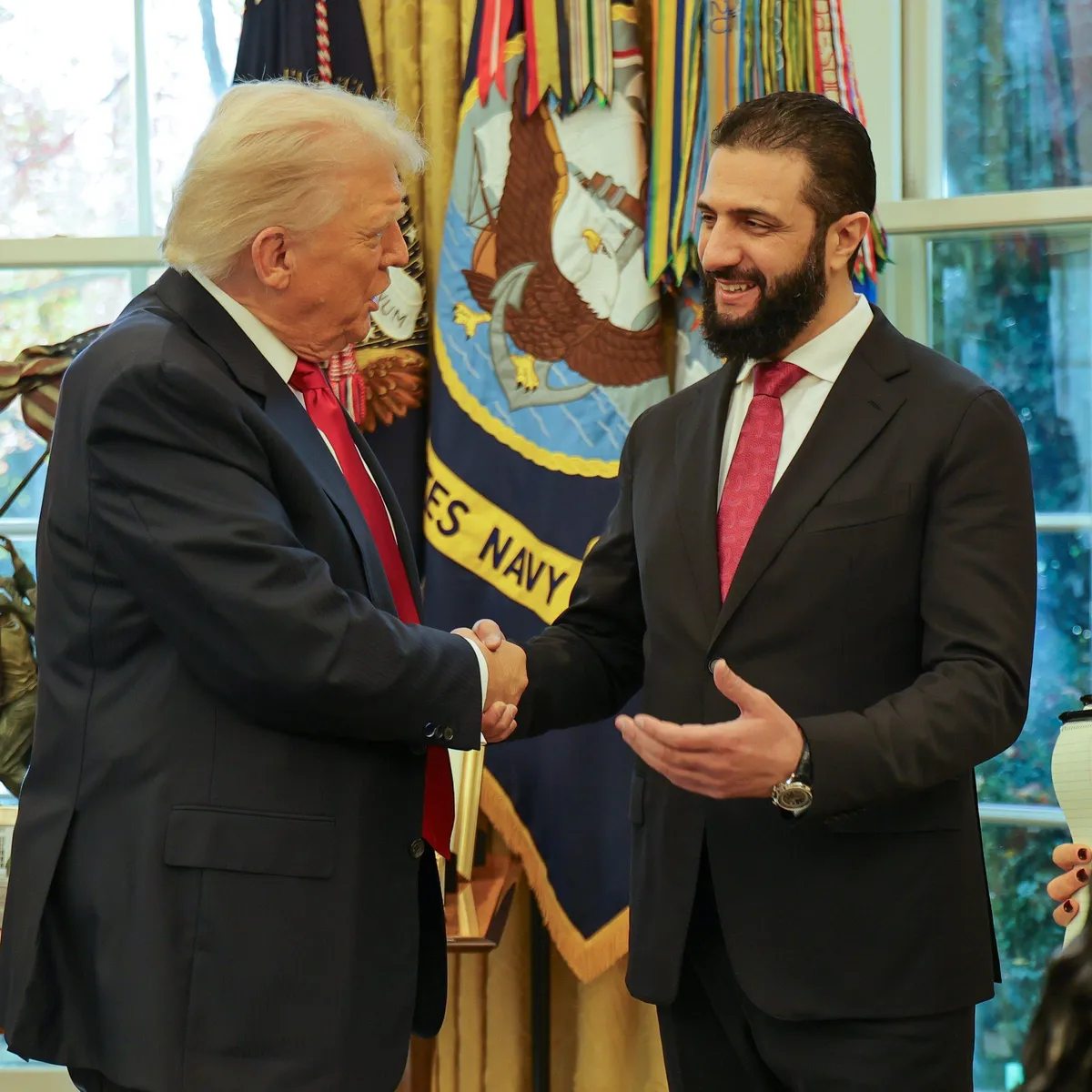
The presidential office was taken by Ahmad al-Sharaa, the former leader of the Hay’at Tahrir al-Sham group; the primary rebellion force in the uprising against the regime. Since then, al-Sharaa has strengthened diplomatic relations with both Western and Arab countries. On November 10, 2025, he held a meeting with United States President Donald Trump, marking the first Syrian president to visit the U.S. since 1967.
Despite promising developments abroad, violence remains within Syria, with hundreds of civilian deaths coming as a result of armed conflict between pro-government groups and the Alawite and Druze minority groups in other regions of the nation. This comes in addition to attacks against former Assad regime officials and workers. Moreover, high tensions exist with Israel who has performed airstrikes and other military operations since al-Assad’s leave, despite al-Sharaa’s statement that he sought no conflict between the two countries.
Syria has struggled to recover from the consequences of the civil war, citing almost 600 civilian deaths or injuries from landmines. Furthermore, even while sanctions have begun to be lifted, the economy has failed to rise, presenting a challenge for meeting the World Bank’s estimated $216 billion price tag on restoring damage from the war. Much of the economic responsibility for repairs has ultimately fallen upon the home and business owners, with minimal external assistance on larger-scale rebuilding projects completed thus far.
People fear that until stability can come over Syria, the economy will struggle through difficulty in garnering international financial support and the uncertainty of economic and physical security associated with the return of the millions of people who have been displaced or fled the country. Al-Sharaa, a Sunni Muslim, and the majority in Syria has been unable to unite the government with the Druze, Kurd, Christian, and Alawite minorities, who are wary of the new government, some of whom have expressed their desire for independent rule. Georgetown University states that “sectarian strife” could lead to the possibility of a second civil war. In efforts to lower chances of war, neighboring Arab countries have worked to partner with Syria to be more inclusive of all Syrian religious and ethnic groups.
Al-Sharaa’s increased partnership with the Western world has also angered many pro-Islamists, who claim that he is a traitor, increasing fear of retaliation by jihad groups. He was previously a member of al-Qaeda, but has now renounced all his ties with the group.
However, amid the strife, the Syrian government has established a council for civil peace and has begun to affirm justice for war crimes committed during the civil war, while keeping the country united. In November 2025, the public trial of numerous people involved in the killings of hundreds of civilians was held. However, the government programs aimed at serving transitional justice have been noted to be underfunded and experts predict that they will prove to be ineffective on a large scale.
With the end of the Assad regime, the Syrian public has also discovered a new sense of freedom. Living in fear for more than fifty years, people can now more freely speak their minds. Though, this does not mean complete democracy, with significant power and influence being placed in the hands of the president and away from the people. A third of Syria’s parliament was appointed by the president, while the remainder was done by private committees, discrete from the greater population.
Although the Syrian state has developed stronger diplomatic ties with foreign nations, and is strengthening internally through justice programs, uncertainty revolving economic stability, destruction from the civil war, and the continued daily assassinations still remain a pressing issue.